Teardown by Dave Meslin
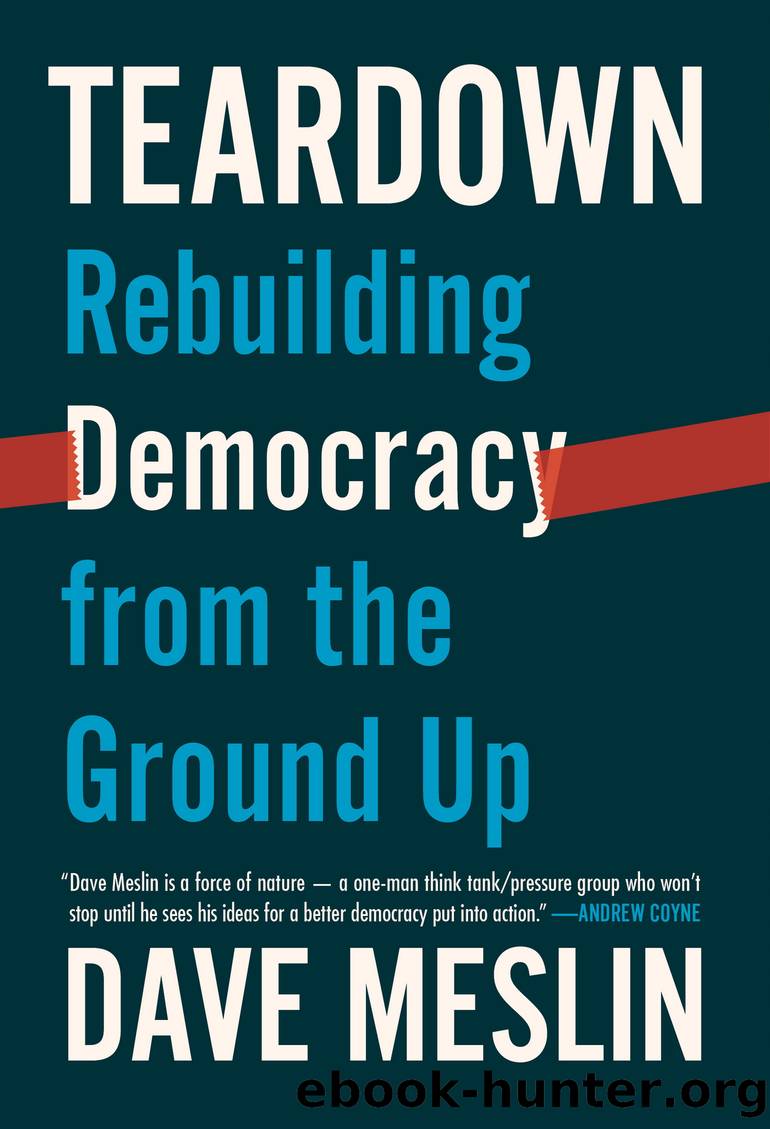
Author:Dave Meslin [Meslin, Dave]
Language: eng
Format: epub
Publisher: Penguin Canada
Published: 2019-05-14T00:00:00+00:00
Canada wouldnât be the first to try this. There are at least three countries that donât arrange their national parliaments based on party affiliation. Both Norwayâs Storting and Swedenâs Riksdag, for example, have seating plans based on geography rather than party. Former Austrian foreign minister Bruno Kreisky once wrote: âIn Sweden, for the first time, I was able to observe a well-functioning democracy. Those holding different political views were treated with the utmost respect; they were not regarded as opponents, if only because in the Swedish Parliament the seating of delegates was not arranged according to party, but by the regions from which the representatives came. Thus, Social Democrats sat next to Conservatives, Communists next to Liberals, peasants next to industrial workers; they came from the same region, they were âLandskapâ in Swedish, and had often been friends since childhood.â
The Icelandic parliament, the Alϸingi (pronounced âall-thing-yâ), has used random seating for a hundred years. At the beginning of each legislative session, each member reaches into a box of numbered balls, just like a Bingo draw, to determine where he or she will sit. I asked Thorstein Magnusson, deputy secretary general of the Alϸingi, about the benefits of this approach, and he told me, âHeckling is more forceful when members are together in one group. Randomized seating has contributed to greater acquaintance between members of different parties than otherwise would be the case.â
We have few examples of non-partisan seating arrangements in North America, but one of the best case studies is Toronto City Council, which has no official parties. I asked Councillor Joe Mihevc to explain the impact that randomized seating has on civility in the chamber. He said: âPolitics is about many things, including working out ideological differences and building trusting relationships, where people agree on some issues and disagree on other issues, all within a context of understanding and respecting differences. It may seem superficial, but the seating plan at council allows for these trusting relationships to form. When you sit beside someone for meeting after meeting, people with different views often see the good reasons behind a difference of opinion. That often leads to a different conversation and a creative solution. It makes council more of a human place.â
I asked Joe what he thought the council would be like if the right and left factions sat in groups on opposite sides, as they do in Parliament. âThis would be disastrous for council,â he told me. âIt would polarize municipal politics needlessly.â Precisely. Randomized seating could also increase the independence of MPs, allowing them to represent their constituents more effectively, rather than just toeing the party line. âRight now, we are all lined up,â said Hyer. âIf one of us stands up contrary to the wishes of the leader or the party, everybody notices instantly.â But with random seating, he noted, âWhen you vote your constituentsâ wishes or your conscience, it will be less obvious that you have voted differently than the other members of your party.â
Randomized seating is just one of many reforms that would change the physical nature of our political spaces.
Download
This site does not store any files on its server. We only index and link to content provided by other sites. Please contact the content providers to delete copyright contents if any and email us, we'll remove relevant links or contents immediately.
| Anthropology | Archaeology |
| Philosophy | Politics & Government |
| Social Sciences | Sociology |
| Women's Studies |
Cecilia; Or, Memoirs of an Heiress — Volume 1 by Fanny Burney(32558)
The Great Music City by Andrea Baker(32018)
Cecilia; Or, Memoirs of an Heiress — Volume 2 by Fanny Burney(31956)
Cecilia; Or, Memoirs of an Heiress — Volume 3 by Fanny Burney(31941)
We're Going to Need More Wine by Gabrielle Union(19046)
All the Missing Girls by Megan Miranda(16026)
Pimp by Iceberg Slim(14506)
For the Love of Europe by Rick Steves(14121)
Bombshells: Glamour Girls of a Lifetime by Sullivan Steve(14073)
Talking to Strangers by Malcolm Gladwell(13370)
Norse Mythology by Gaiman Neil(13363)
Fifty Shades Freed by E L James(13239)
Mindhunter: Inside the FBI's Elite Serial Crime Unit by John E. Douglas & Mark Olshaker(9341)
Crazy Rich Asians by Kevin Kwan(9291)
The Lost Art of Listening by Michael P. Nichols(7506)
Enlightenment Now: The Case for Reason, Science, Humanism, and Progress by Steven Pinker(7313)
The Four Agreements by Don Miguel Ruiz(6765)
Bad Blood by John Carreyrou(6621)
Weapons of Math Destruction by Cathy O'Neil(6279)
